
An After Action Report
It was one of those dark, soaking Christmas evenings when the rain falls with professional enthusiasm, the sherry is taken more for courage than celebration, and the dice—far from rolling smoothly—display a spiteful intelligence that causes naval officers of the Napoleonic persuasion to question not merely their career choices, but several of their life principles as well.
The French flotilla, commanded by the unflappably optimistic Commodore Steve, with Captain John and the irrepressible Captain Ziggy in close attendance, slid onto the Black Seas tabletop with all the quiet confidence of gentlemen who fully intend to be somewhere else before trouble arrives. Their brief was simple: proceed discreetly northward, or, failing discretion, remove oneself with dignity.
Alas, discretion immediately packed a small suitcase and left the room.
For from the opposite horizon surged the Royal Navy, commanded by Admiral Gerry, a man of such resolute bearing that even his tape measure stands to attention. With him sailed the redoubtable Captain Williams, whose ships move with the brisk certainty of a tea tray being carried toward an unsuspecting aunt.
The Wind, That Treacherous Co-Conspirator
At this point, Fate—who had clearly been dipping into the Christmas punch—decided to involve herself. The wind, her principal instrument of mischief, swung violently against the French line with the enthusiasm of a weather vane possessed. The two lead French ships found themselves stranded like polite party guests who had missed the last train home, while the rest of the line advanced northward with all the urgency of treacle on winter stone.
The Royal Navy, scenting opportunity like a retriever spotting an unattended sausage, made all speed in pursuit—only to suffer an outbreak of nautical congestion. Ships bumping, sidling, and politely obstructing one another, the British line resembled less a fearsome battle fleet and more a supermarket car park on Christmas Eve.
A Brief Moment of French Cheerfulness
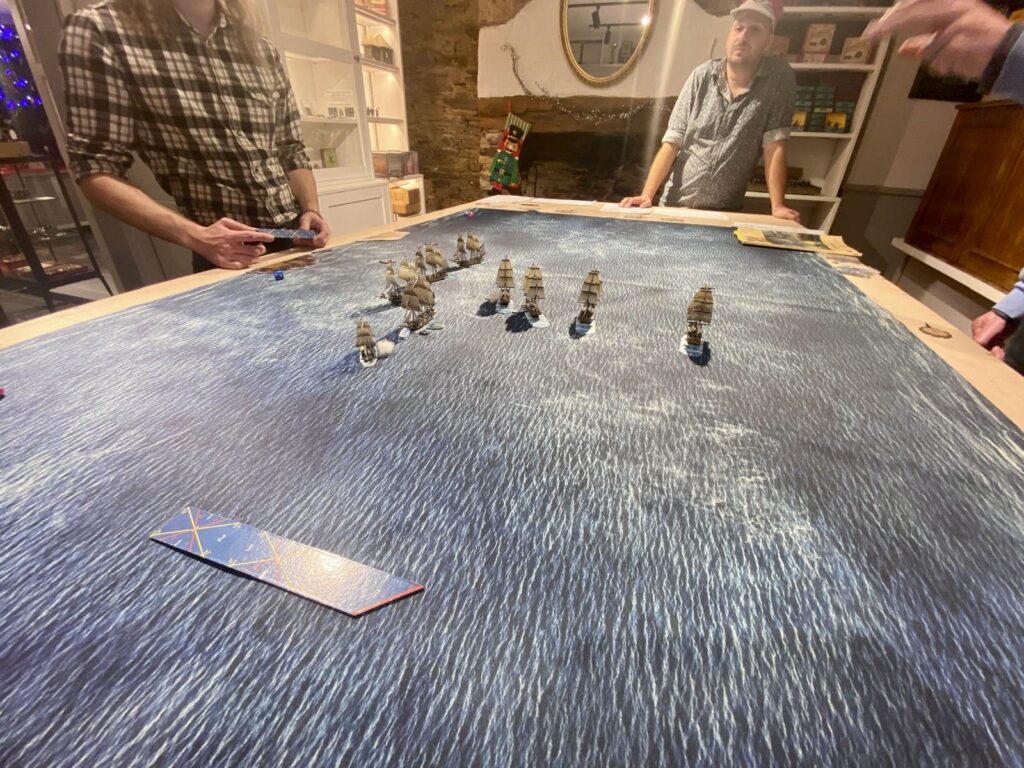
In the ensuing chaotic pass, the French gunners found a brief and heartening purpose in life. A handful of remarkably well-timed critical hits rattled the Royal Navy like teaspoons in a nervous saucer. For a moment it appeared that Commodore Steve’s expedition might yet be remembered as dashing rather than deeply unfortunate.
But Fate, having given, now retracted with interest.
Raking Fire and Bad Decisions
As the French continued to jog doggedly in entirely the wrong direction, the Royal Navy—having finally untangled itself from its own elbows—swept around the enemy’s rear with the air of men who had at last found their spectacles and were not amused.
What followed was a raking of such pointed discourtesy that the Andromaque was thoroughly acquainted with the full industrial output of the Royal Navy, emerging like a ship that had mistakenly wandered into a highly exclusive but very aggressive cheese grater. Her timbers groaned, her decks ran with chaos, and her crew very likely reconsidered their pension arrangements.
Meanwhile, one Royal Navy vessel developed an alarming interest in nearby rocks, while the rest of the fleet attempted heroic but geometrically ambitious turning manoeuvres in pursuit of a French line that was still, quite heroically, going the wrong way.
Time, That Great Umpire
At precisely this moment—when confusion was peaking, broadsides were finding their mark, and muttered oaths were approaching operatic levels—the game was called. The French, battered by wind, fire, and navigational disobedience, were in no condition to claim success. The Andromaque’s condition alone settled the matter.
Result: Royal Navy Victory, 2–0.
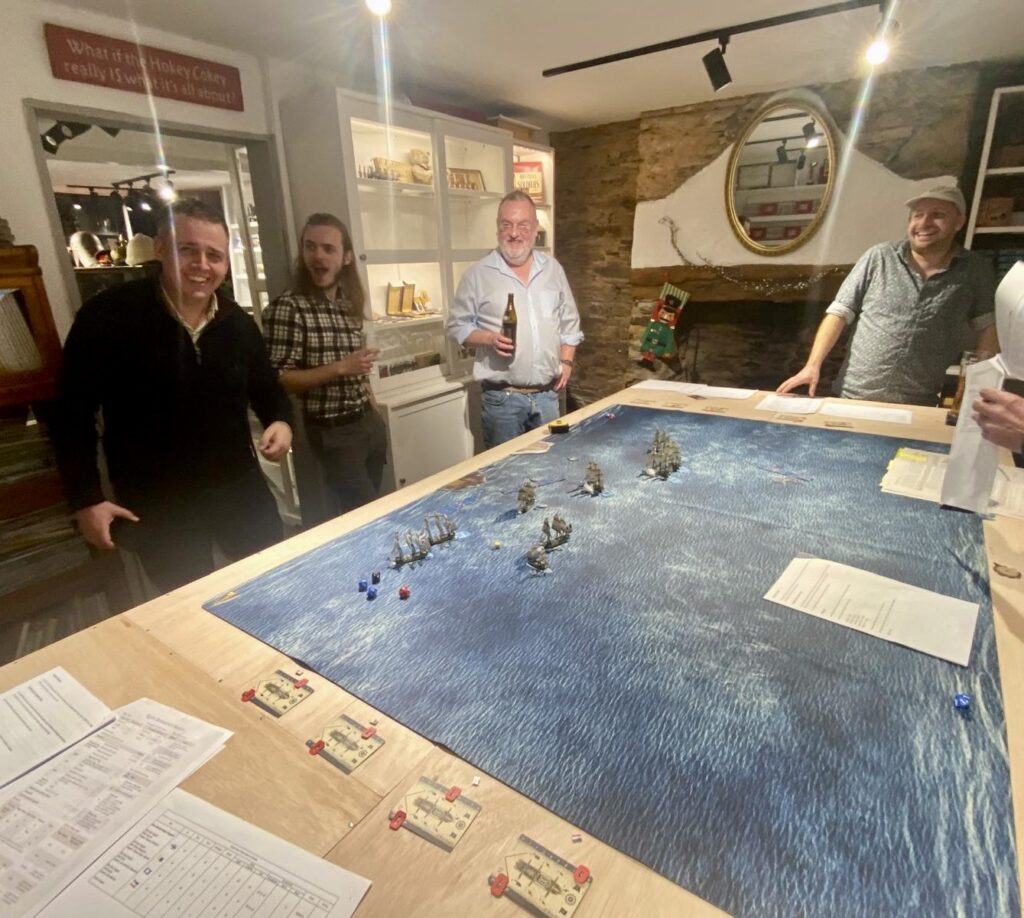
Admiral Gerry accepted victory with the calm satisfaction of a man whose trousers have not caught fire today, while Commodore Steve bore defeat with the stoicism of one who knows full well that the wind, like a demanding aunt, cannot be trusted under any circumstances. And thus concluded the Battle of the Christmas Table at Modbury—where the guns thundered, the wind betrayed, and no one, on either side, could for the life of them remember why they had so confidently planned to sail straight north in December.
Leave a Reply